


By AMEX Moving & Storage · Published · 7 min read
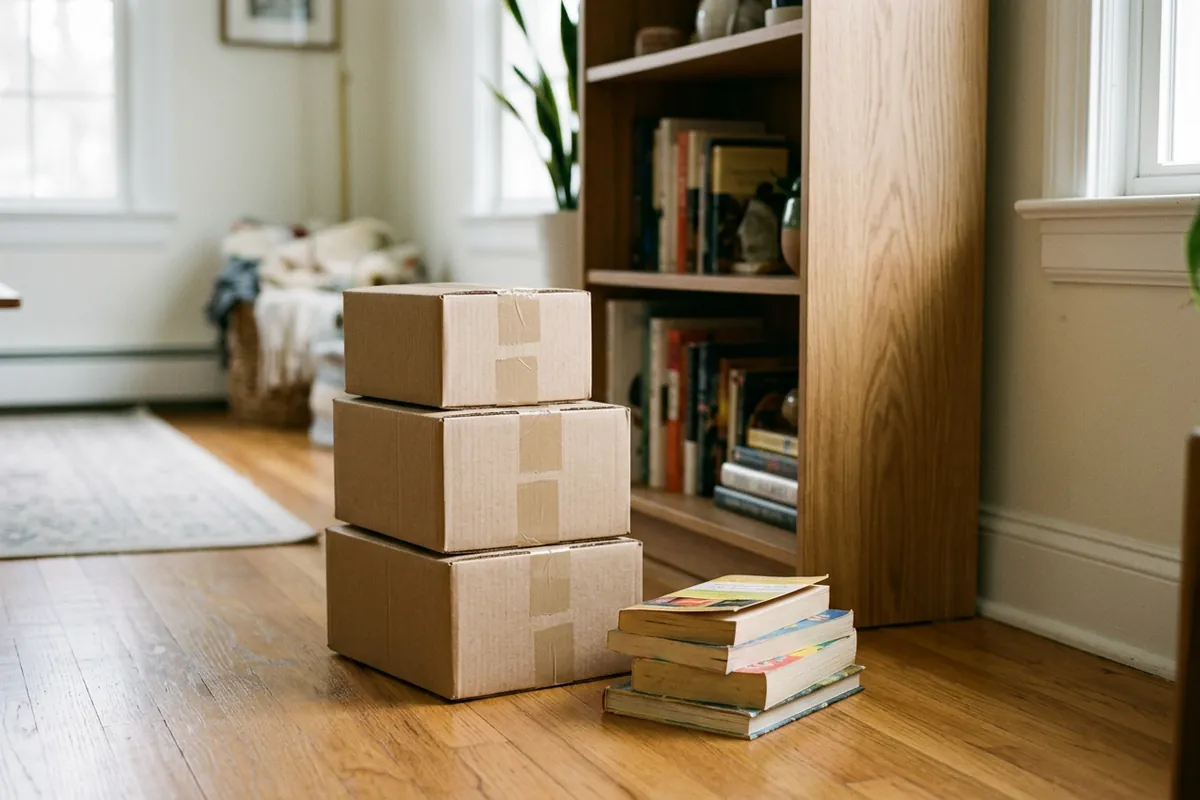
Books are the sneakiest weight in any move. A box of paperbacks looks harmless until it tears through the bottom on the stairs. Learning how to pack books for moving comes down to three choices: how many books to bring, how small the box should be, and how to lay the books inside.
Below you will find a fast sorting method, a table that sorts out the conflicting advice on spines, a way to estimate your box count with a tape measure, and extra steps for the books that matter most to you.
Sort first: which books earn a seat in the truck
Every book you carry costs you time, tape and lifting. The easiest box to pack is the one you never fill, so edit the shelves before you touch a box. Be honest about what you will read again.
- Pull everything off one bookcase at a time and make three piles: keep close, keep boxed, and go.
- Send the go pile to a used bookstore, a library sale, a school or a friend. Unread freebies and review copies are the usual suspects.
- Set aside the few books you will want in your first week, such as a cookbook, a reference book or whatever you are halfway through, and pack them in your keep-out bag.
- Keep a short list of anything rare, signed or irreplaceable. Those get special handling, covered later in this guide.
How to pack books for moving: small boxes and a weight cap
Books are dense, so use small boxes. Ten light boxes are easier to carry than five heavy ones, and a box that is too big for books will tear or collapse. Liquor-store boxes work well because they are built for heavy bottles, and North American Van Lines points out that ordinary boxes are often too weak for books.
Most packers aim for about 35 to 40 pounds at most. HireAHelper suggests a box of about 1.5 cubic feet and a ceiling of 40 pounds. After a few books go in, lift gently from the bottom. If it strains your back or arms, take some out.
- Tape the bottom seam with two or three layers, and tape the inside seam too if the box is recycled.
- Add a piece of flat cardboard on the floor of the box if the books are especially heavy.
- Stand a bathroom scale near your packing station and weigh the first few boxes. After that you will judge the weight by feel.
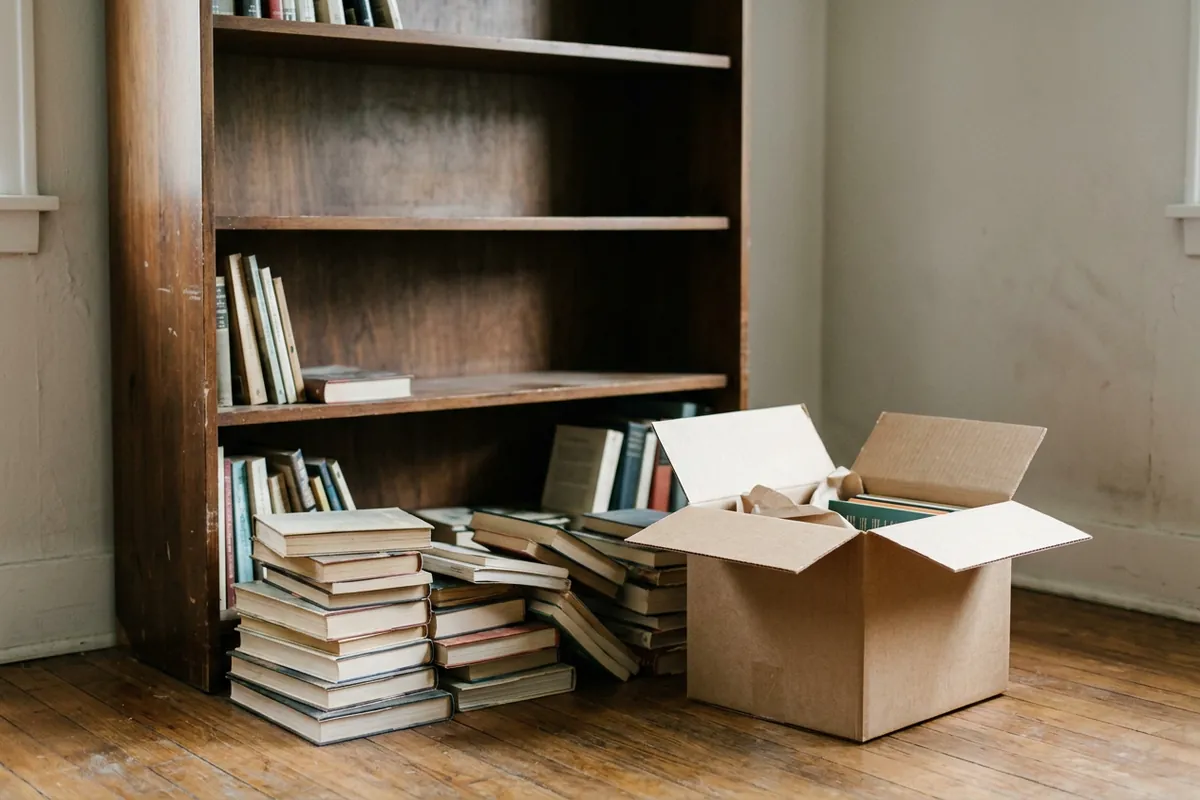
Sort and donate before you pack.
Spine up, spine down or flat? What the packers say
Ask three moving companies and you may hear three answers. The sources below do not fully agree, but there is real common ground. Never pack books spine-up, never stand them on their page edges, and never leave room for them to slide.
| Type of book | Common recommendation | Watch out for |
|---|---|---|
| Paperbacks | Flat in one layer, or spine-down, snug but not bent | Too much pressure on the spines |
| Hardcovers | Flat with the heaviest at the bottom, or upright with spines against the box wall | Overloading, which strains the box seams |
| Oversized and art books | Flat, largest at the bottom, three or four per box | Mixing with small books that can get crushed |
| Rare and collectible books | Wrapped, in their own labeled box | Plain packing paper, which is not acid-free |
| Comics and magazines | Sleeved with a backing board between them | Bending or loose stacks |
Whichever convention you choose, group books by size so large volumes do not crush small ones, and keep each box consistent.
Packing books in boxes: tape, fill and load
A well-packed book box feels solid when you push on it. If books shift when you shake the box gently, add filler. Crumpled paper, clean towels, scarves and pillows all work, and they let you use leftover space without adding weight.
- Fill gaps in other boxes with books. Slipping a few between pots, pillows or linens keeps those items from moving and spreads the weight across more boxes.
- Write HEAVY BOOKS on the box and the room it belongs in. Movers lift safer when they know what is inside.
- Load heavy book boxes on the floor of the truck near the back, with lighter boxes on top.
- If rain is likely on moving day, consider plastic bins, since water soaks through cardboard fast.
How many books per box? Estimate it by measuring
Nobody can give you a reliable number for how many books per box, because paperbacks, hardcovers and coffee-table books vary so much. Measure your own instead. A small box usually holds two rows of books with room left over at the side, so your shelves are the best guide.
- Measure the width of each shelf with a tape measure and add them up for a total in inches.
- Pack one typical box of your books, weigh it, and note how many shelf inches it swallowed.
- Divide your total shelf inches by that number and round up. Add a few extra boxes for oversized books.
- Check your math against the weight cap. If your test box is over 40 pounds, run the numbers again with a lighter box.
For example, if a test box takes 12 inches of shelf and you have 480 inches of shelving, you need about 40 boxes. Those figures are only an example, so plug in your own.
Moving a large book collection
A library of thousands of books is a different problem from one bookcase. Spread the load: put books in rolling suitcases and duffels alongside small boxes, so no single package is a back injury waiting to happen. Book Riot also suggests using books as filler around other items to avoid dedicating whole boxes to them.
If the move is long distance, think about storage too. HireAHelper recommends a climate-controlled space below 70 degrees with humidity around 30 to 55 percent for books, and plastic bins over cardboard. AMEX Moving & Storage includes 30 days of free climate-controlled storage with every long-distance move, with longer stays available.
How to pack books to avoid damage: rare and valuable copies
For rare, signed or old books, plain packing paper is not enough because it contains acids that can yellow covers over time. Wrap each book in acid-free tissue so the covers do not touch, then add a layer of packing paper. Place it toward the middle of the box, away from the walls, and keep these books in a box of their own.
- Dry books completely before packing, since a little mildew spreads quickly.
- Keep wrapping loose and allow some airflow, so plastic does not trap moisture.
- Slip silica gel packets into boxes of valuable books if the weather is humid.
- Carry the truly irreplaceable ones in your own car.
Once you know how to pack books for moving, the rest is repetition. Prefer to hand off the heavy lifting? AMEX can pack a whole library under a full plan, or just the rare volumes under a fragile-only plan, and you can pack the rest yourself with materials stocked on every truck. Details are on our packing and crating page.
Our moving checklist puts book packing in the right week, and the dish packing guide and our moving tips cover the rest of the house. When you are ready for numbers, request a free quote.